Friday, July 14, 2006

Parental "Love" and "Undertanding": disowning a publicly gay son

I have come across this story rather late. 40 year old "Crown-Prince" Manvendra Singh Gohil was disowned by his parents for going public about being gay.
Manvendra is the son of the "king" of one of the richest erstwhile princely states of India, Rajpipla in south-eastern Gujarat. He has been an activist working for prevention of the spread of HIV/AIDS among gay men in Gujarat, and had originally come out as gay to his parents in 2002. He says,
Four years ago I had a nervous breakdown and through that breakdown I spoke to my psychotherapist who helped me. I told my parents I was gay initially it was difficult for them to accept it. They tried to convert me to heterosexuality. The doctors told them that was not possible. And I guess they could not deal with the stigma.
But the straw that apparently broke the proverbial camel's back was his coming out in recent interview to a Gujarat daily. Times of India quotes him:
However, they may not have expected that I would go public with the issue. I did so by giving an interview that was carried prominently. I also said gay relationships were not uncommon in royal families. This, along with my recent interviews regarding a documentary film on gay relationships, seems to have prompted the action.
Manvendra heard about his disinheritance from newspapers-- two public notices were issued by the "royal" family on 22 June. One of them said:
Manvendra is not in control of his mother and involved in activities unacceptable to society”, said one notice, issued by his mother. “Hence, he ceases to have rights as a son over the family property and the power of attorney issued to him also stands cancelled. Henceforth, no one must refer to my name as mother of Manvendra. If any individual or organization dares to do so, it will invite contempt proceedings against him.
All I want to do is to ensure there is a discussion and people talk about homosexuality and that we get some sort of social status.
In its days, the erstwhile princely state of Rajpipla had a thirteen gun salute, my Thirteen Gun Salute to Manvendra.

Read More...

My Paris travelogue...

... is on my travel blog now. The complete one, with photos.

Since this was probably the first time I carried my laptop to a trip and my blogs are rather new, I was able to maintain a regular travelogue during the trip. Just the last two days (one and a half actually) were missing. I was first lazy to write these two days, and also to process, select, and insert the photos. I solved the usual procrastination problem by putting in the photos day by day and putting the posts up, and then today wrote up the last two days, inserted the photos and made them public. Feels good now. This is the second time in my life I have a full travelogue. The first time was of course a written one during my college trip to Rajasthan in Nov-Dec 1992. Since then I have never finished my travelogues (if I at all did start one). I almost took the one during the Spain trip, but gave up during the last few days. I didn't proceed beyond the first 2 days during my Greece trip last year.

Read More...

Tuesday, July 11, 2006

the past week and a hectic weekend

Come summer, and life seems to become faster. There is so much to do, so many people to meet up with.


The Sunday after the parade (2nd July), a few of us CSers met up at Marcus' place in the afternoon. Couchsurfing had died the previous week, with Casey the founder send an emotionally charged obitituary. Of course lots of people couldn't accept it, and quite a few people started to try to recover cached stuff. So did Marcus and a few other geeks here. The Sunday meeting was to discuss this and the planned 10-day CS meeting in Eisenstadt and Vienna at the end of July. The Viennese CS recovery efforts seemed quite redundant, as Casey and a large team of volunteers who turned up in Montreal were at it day and night and expected to have the site back and running in a few days. We spoke to Casey on telephone. And indeed, it is up and fully functional (well a few recent modifications to profiles, friends links, references etc have been lost) since this Friday (7th), I think.

On Monday I finally went to the gym after quite a while.

On Tuesday the institute had organized a Football World Cup Party outside with sausages and drinks and a large screen for viewing the semi-final between Germany and Italy. Although I'm certainly not into football, I enjoy it in these kinds of atmospheres-- there were lots of Germans and Italians around. Germany lost, and the Italians ultimately went on to win the cup on Sunday.

A British girl called Katie had posted on Vienna Expats about wanting to start a free print magazine in English for expats in Vienna. There wasn't much enthusiasm on VE, but I found it to be a great idea. We met up on Wednesday evening and chatted quite a bit. She has written for such a magazine for German-speakers in London. The English-language expat magazine in Berlin apparently became so popular that they had to change it to a proper subscription-magazine. Katie has a very good idea of what she wants and has planned almost everything. She wants to start it from October, and we discussed that I'd write the monthly restaurant review column and contribute to features-- one on CS, for example.

Theatre group on Thursday was fun-- Clark and Rosie were not there, but we had good fun and always watched the video of their performance of our piece from Pulp Fiction at a private function on Monday. I had not participated (as I was away in Paris during the rehersals) and Justin did "my" (Samuel Jackson's) role. Ella did the role Claudia had done (Tarentino). The audience wasn't great, and there weren't a lot of laughs. Next Thursday (day after tomorrwo) Ella will be away, but we do our proper rehersals for Daylight Saving. I haven't learnt any of my lines yet...

I went to the gym for a quick session on Friday before meeting up with Adam S. at Cafe Berg. The food was excellent like last time (I wonder why I neglected this place for so long)-- I had beef pepper steak, and afterwards we went to the cinema to watch The Lake House. The film has an interesting concept, but a different ending would have been better. I realized I'm not a big fan of Keanu Reeves.

I slept in on Saturday, and then went shopping for shoes with Fabien. I bought three pairs (well one was very cheap-- EUR 20), and Fabien bought a pair. I also bought earphones and a 512 MB USB stick. Later we went to Fabien's place and ate ice cream and we listened to the cd of Jethu's songs that I had brought for him-- he said he liked them. Since the weather was so beautiful, we decided to go to the Donauinsel (Danube Island), but as we were getting out, I closed the inner door of Fabien's flat (it has a double door) by mistake. He doesn't carry keys for it, and so we had to call the locksmith to open the door, and had to pay him EUR 160 for a 30 second job (we shared the expense). We had dinner at a Greek place on the Donauinsel that they call "Copa Kagrana" (after the Copacabana beach in Brazil) because that district is called Kagran. The food was really good.

I got up at 9 am on Sunday as I had said I'd go swimming with Fabien. Sunanda called soon after (very conveniently we can speak after I wake up in the morning in Vienna and before she goes to bed in San Fancisco) and we spoke for half an hour, but couldn't finish the conversation because Fabien called to "wake" me.
The swimming pool he had selected was near the Schönbrunn (but not the expensive one in the Schönbrunn). The pool here is indoor, but there is a decent sized outdoor park attached where people lie in the sun. The place was full of families, and hence kids. I am a bad swimmer. Bad in the sense that I cannot do the popular (and easier) breast-stroke. I only go for free-style, but in this I cannot do the associated rhythmic breathing. As a result, I either have to keep my head up all the time, which is terribly tiring because of the immense drag, or I have to do it in one breath. So of course doing lengths like everyone else is difficult for me, and I prefer to do breadths (in one breath), but then this is not very convenient as one bumps into everyone else because they are doing lengths. However this pool was good in a way because most of the people in it were kids jumping around or playing with balls in the shallow part. There were few others who were doing lengths, and so I could easily do a lot of breadths in the deep part.
Let's see what happens in the next weeks. Fabien wants to go to the one in the Schönbrunn because he thinks a lot of gay people go there, but that would be reason I wouldn't want to go there and show everybody my poor swimming skills, not to speak of showing off my embarassing physique...
I had lunch at home-- "Greek" salad and spaghetti, and then called up home. Ma had gone out and I spoke to Baba for quite a bit.
Met up with Fabien again to go to Cafe Berg at 3 pm. A while ago I had started a club called FriendsinVienna on Gayromeo to meet people in a non-sexual English speaking enviroment. A lot of people (40 at the time of blogging) joined up, but my attempts at prodding them to talk in the forums weren't very successful. I had tried to organized two meetings before, and few responded and then backed out. This was my third attempt. I had been anonymous as the owner/organizer in previous attempts. Now I have "come out" and made sure my friends were coming. Nenad and Marcus had signed up for the club and had promised to support it. Nenad isn't around I think (he hasn't logged on for a while). Marcus was undecided and also said he doesn't like posting on the forum. Like last times, another guy who had signed up backed out a day before. Fabian and I went to Cafe Berg. Marcus and Adam S. joined later. Although no one else turned up, it was fun.
Afterwards, Fabien and I were taking a walk and had in fact returning to our respective flats when we saw a Vietnamese Restaurant near Karlsplatz. We both said we wanted to eat there sometime. I half jokingly suggested "now", and Fabien said "yes, why not? We should be spontaneous". We ordered a starter each-- he, a plate of fried prawns, and I, some delicious stuffed chicken wings. For the main course we both ordered the same thing, which turned out to be very elaborate. Each of us had 7-8 thin "rice-papers" and a plate with some noodles, mashed beef rolled in basil (?) leaves, and some leaves and shoots. One had to roll the stuff on the plate in the rice-papers and dip it in sauce before eating.


Not a bad weekend, albeit a bit expensive, considering all the eating out, shopping and the locksmith.

Yesterday and today I have been updating blogs. I have updated 10 days of my Paris trip in my travelogue (i.e., put in the photos) and now this main blog. The last two days of the travelogue still remain. I should actually be doing other stuff. For example, tomorrow I have to present a paper in the PcG journal club of Leonie's group, and I have selected Jürg's complicated paper, but my favourite from his lab. I should be working on that... although I was in his lab when this work was being done, the experiments and the interpretations are so complicated that I have to really spend time on reading it. Also I will have CS guests tomorrow, so a massive cleaning up of the flat is urgently required.
Plus of course there is lots of work in the lab that I have been neglecting.

Read More...

Monday, July 03, 2006

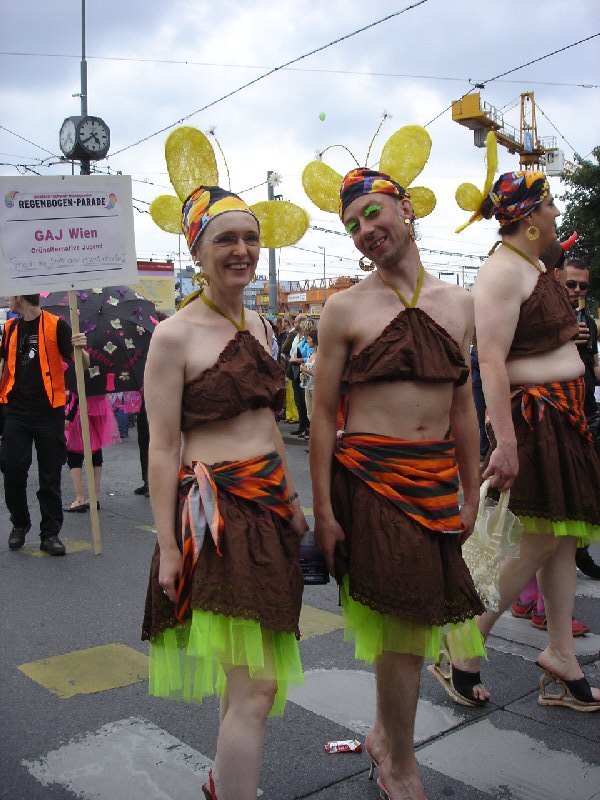
Regenbogen Parade in Vienna

(started on 3 July, completed and posted on 11 July)
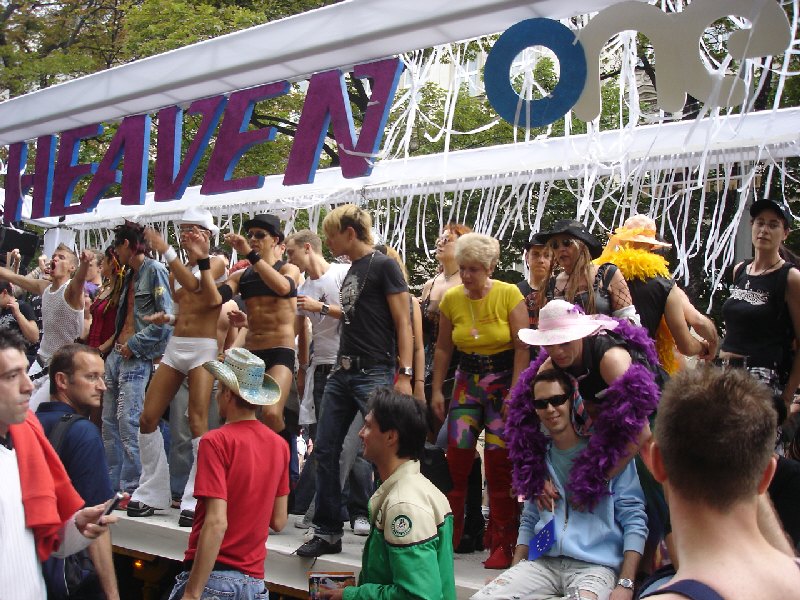
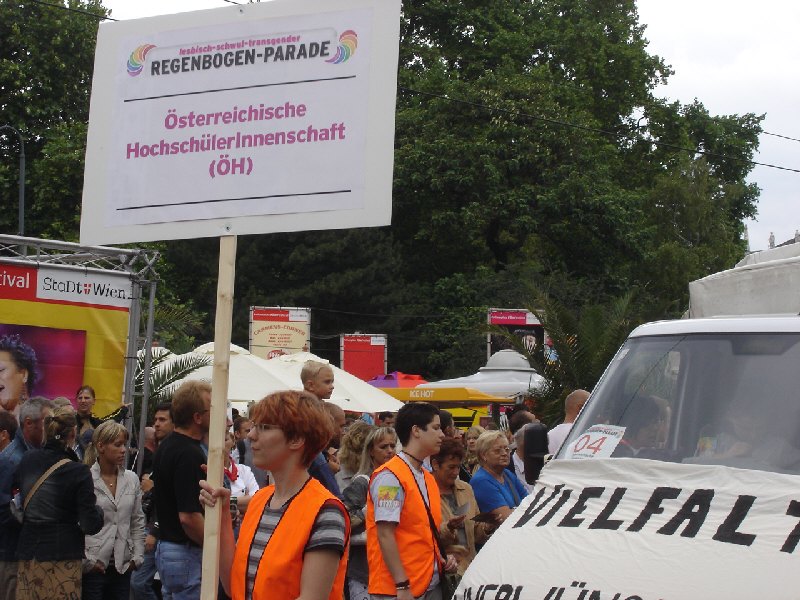
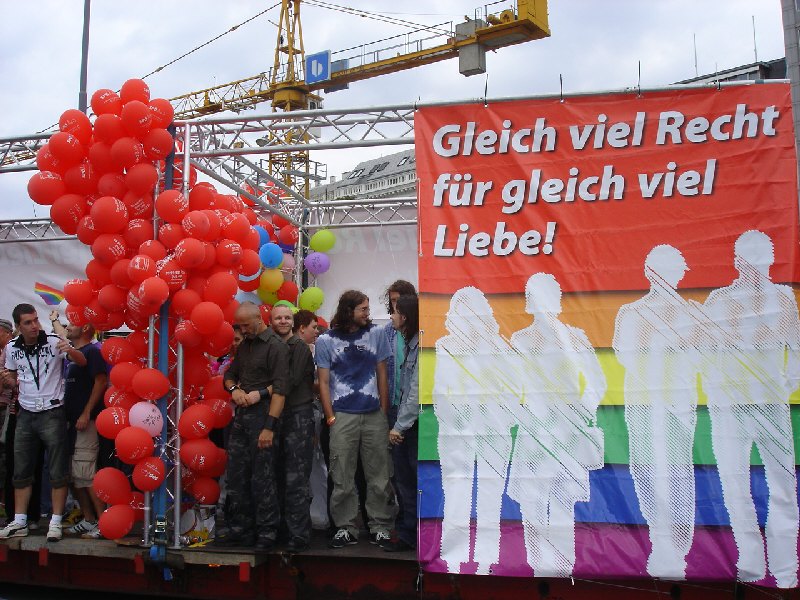
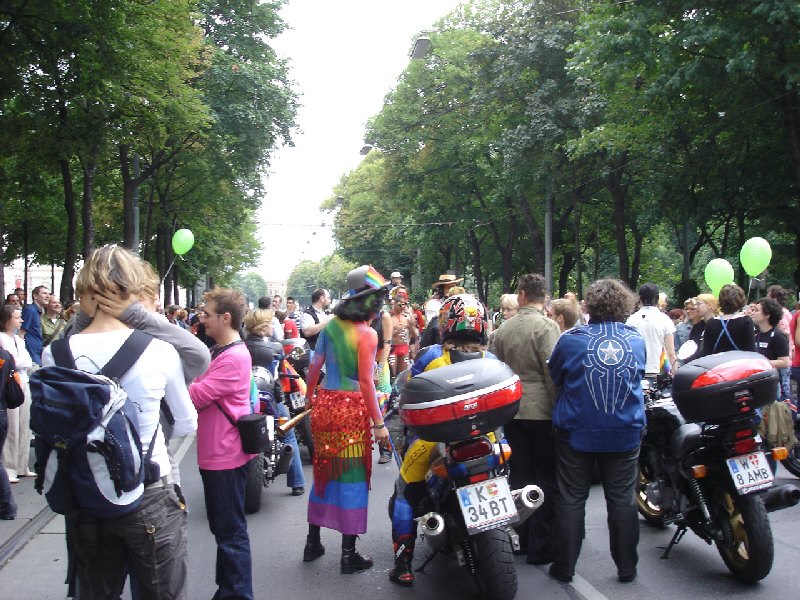
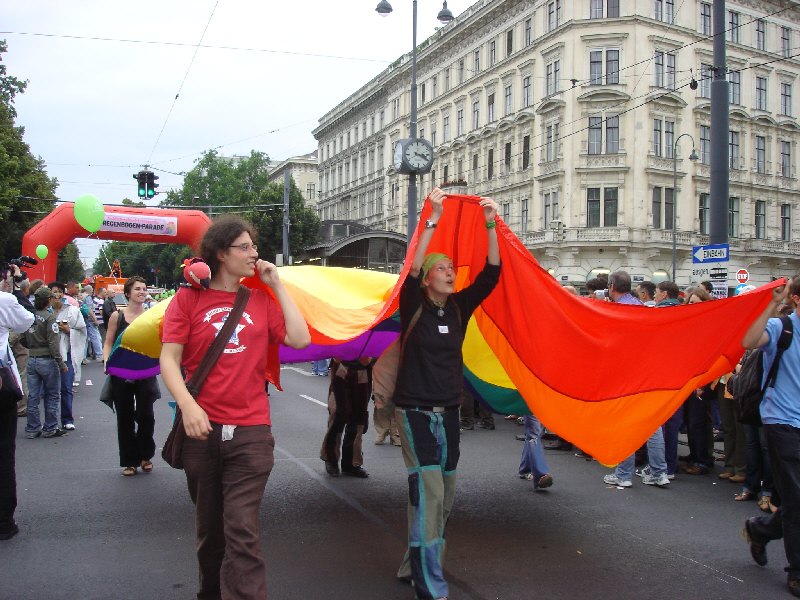
The Regenbogen Parade ("Rainbow"/Gay Parade) of Vienna was on Saturday, 1 July. The previous week had excellent weather, but the forecast for Saturday was bad-- cloudy and rain. Fortunately there wasn't anything more than a few drops here and there.

Since the more than three years that I have been in Vienna, I have attended all of these, though to varying extents. Saturday's was possibly the maximum time I spent in it and in the subsequent events.

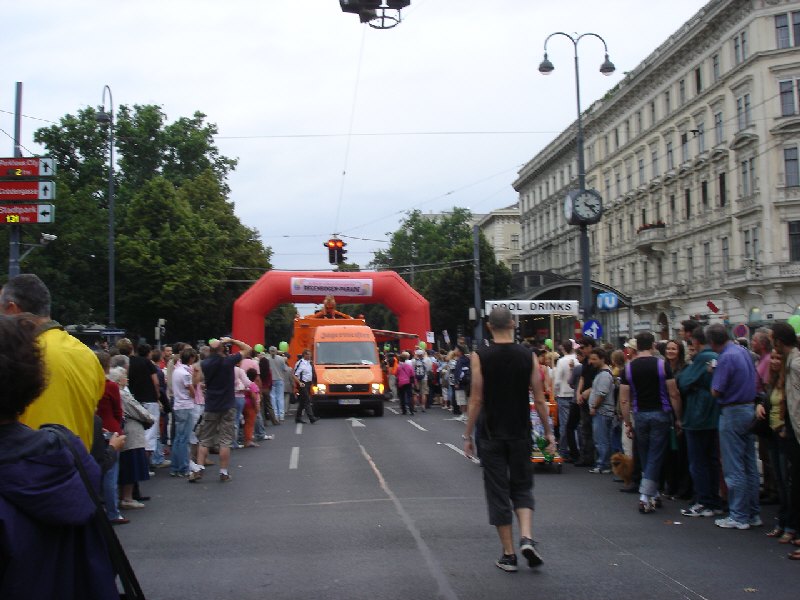
I met Clovis and Michael around 3 pm in front of the Village Cinemas. The parade had just started from the Stadtpark. Although this is a couple of minutes from my place, I have never seen the actual beginning. This year we just about missed it. It started at exactly 3 pm, and there was a slight misunderstanding about where exactly Clovis & Michael and I would meet, so by the time we found each other and made it to Stubentor where the Stadtpark ends, it had already started.

The parade starts at the Stadtpark and goes along the Ring via Swedenplatz, Schottenring, Schottentor, in front of the Rathaus/Burgtheater and the Parliament and ends at the Heldenplatz (or in the courtyard of the Museumsquartier as it did in 2003, my first Gay Parade in Vienna-- actually my first Gay Parade, if I don't count the one in Berlin that we had stumbled upon. [I was visiting Hari in Berlin in 1999 and it just happened that it was the Gay Parade weekend. At that time Hari (or nobody) knew that I was gay, and while we were loitering around Berlin, we stumbled upon a parade that we much later realized was the Gay Pride Parade... I should blog on this at some point.] It was also during the 2003 Regenbogen Parade that I first met Clovis. We had "met" on the internet and had been exchanging emails and had planned to meet up during the parade. However the parade was so noisy, that we couldn't hear each others' phone calls and finally met when the parade ended at the MQ.

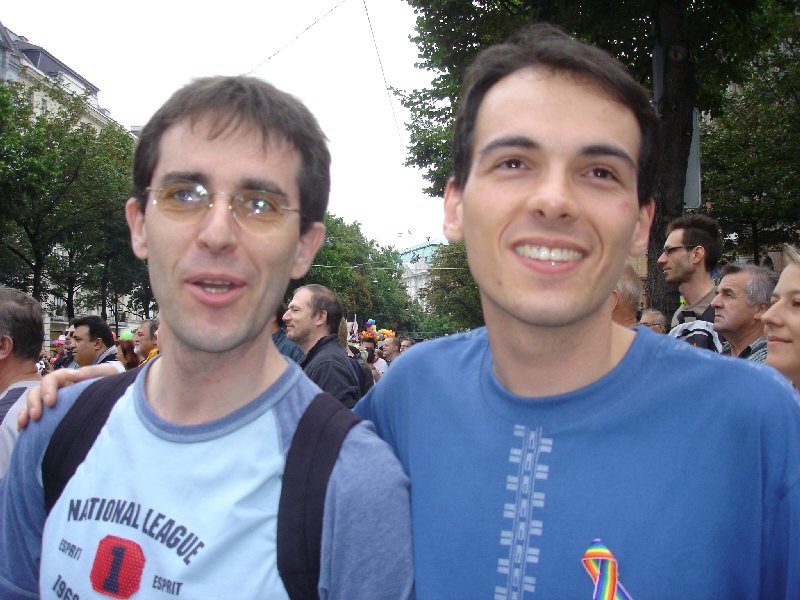
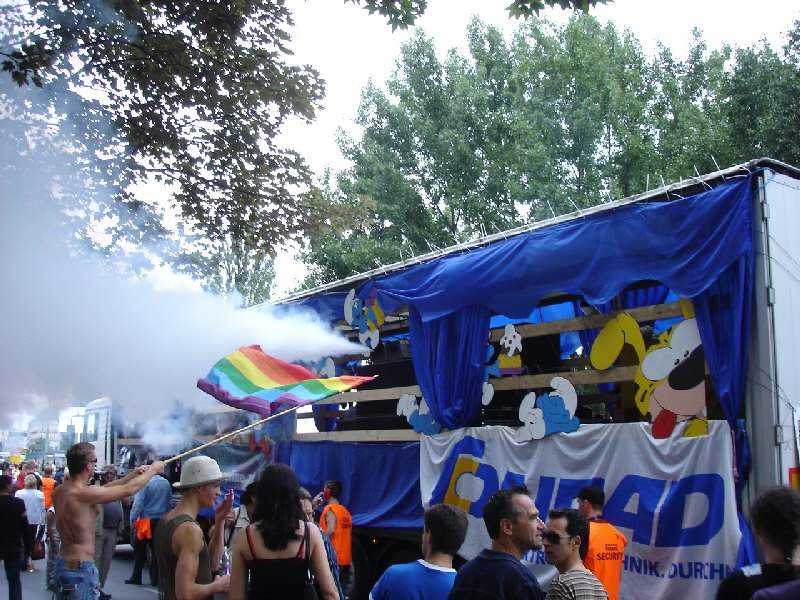
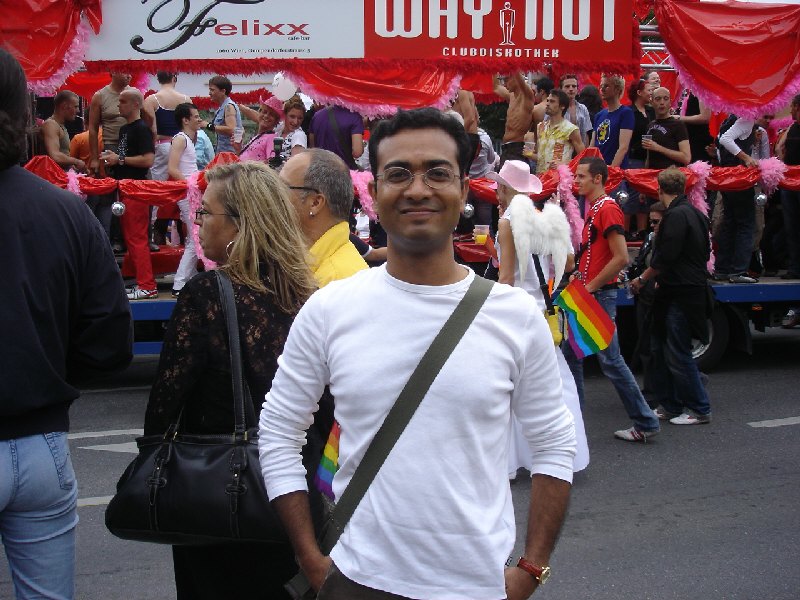
We waited for all the floats to pass by and then started walking along with the parade, taking photos, chatting, catching up, meeting friends and acquaintences (mainly Clovis'), eating ice creams and ogling at people. This year I also had the rainbow flag sticking in my bag... and that was nice, because since I don't dress up for the occasion, and my usual attire is very non-gay, an onlooker wouldn't be able to figure out whether I'm just another onlooker or tourist taking photos, or am actually a participant. The flag I bought in Paris was very suitable for the purpose.

After the Parisian parade, this one really looked small, and the floats rather simple. But it was good fun.
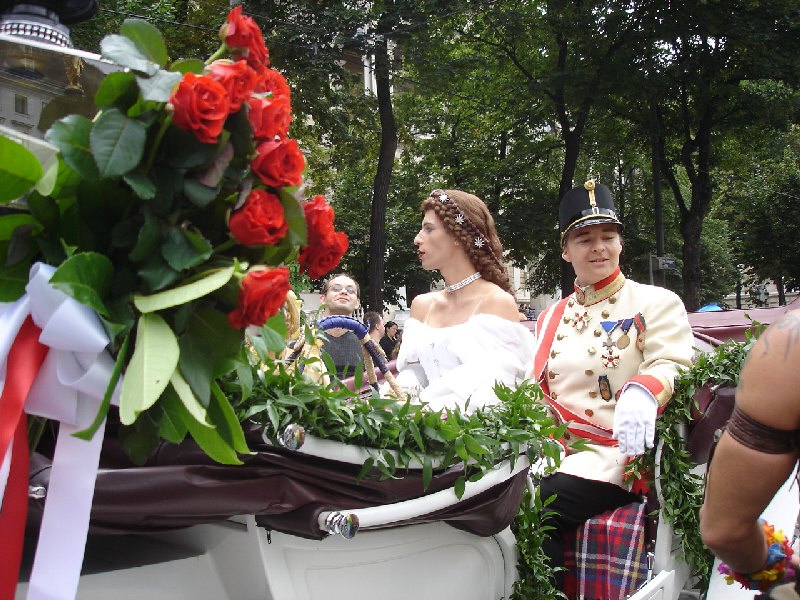
The beginning of the parade had a carriage with a Sissi and a Franz-Josef, both in drag-- so a guy was Sissi and a girl Franz-Josef.
There were the usual floats of the the political parties: the Socialists and the Greens-- the latter distributing green balloons. And of course there was a float of HOSI, the organizers of the parade.


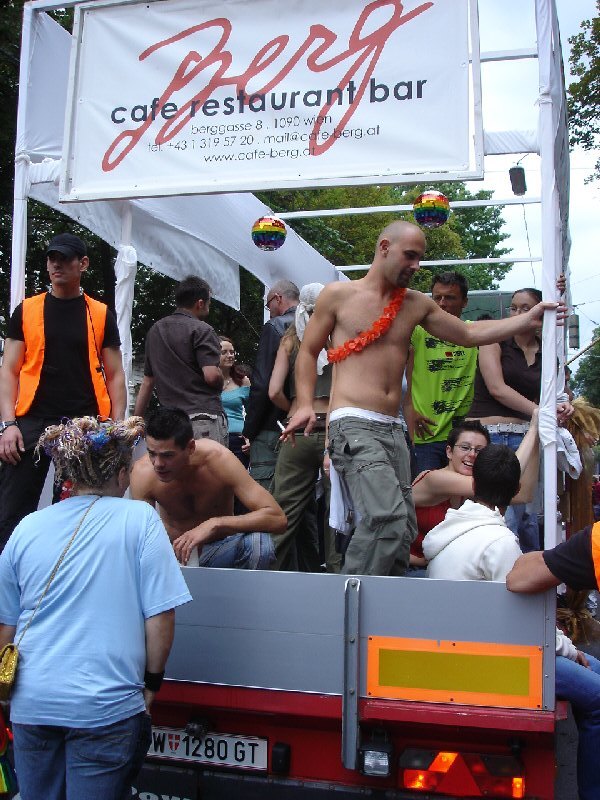
The Rosa Lila Villa, a GLBT resource centre in Vienna that also has a great cafe-- Cafe Willendorf; Cafe Berg, another lovely cafe with excellent food; Felixx, a nice bar, & Why Not, a popular or unpopular (depends on your perspective) tiny disco that are jointly owned; and Löwenherz the gay bookshop next door to Cafe Berg-- all had their floats.


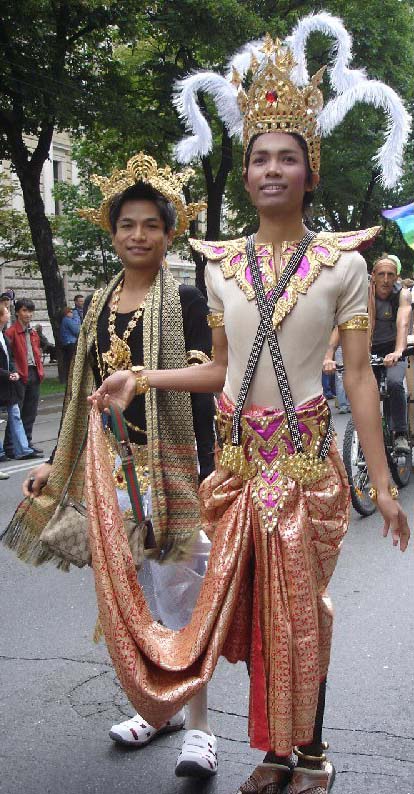
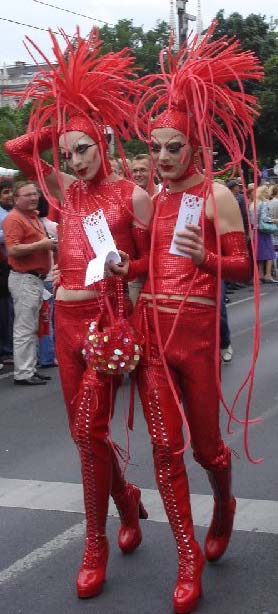
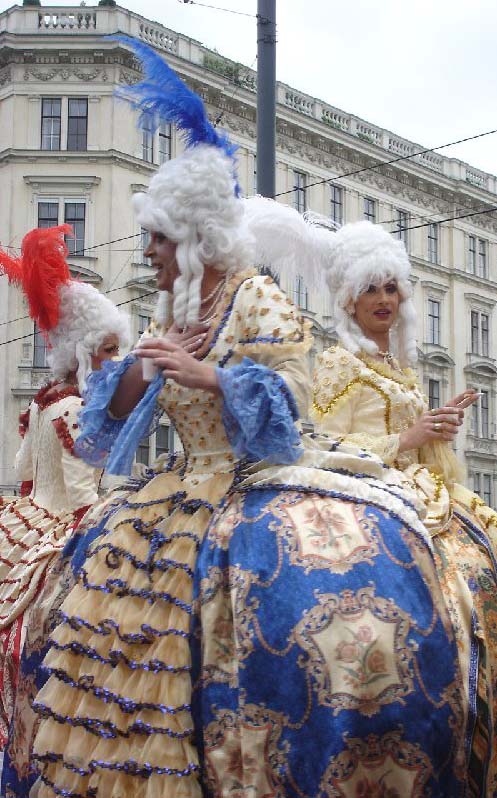
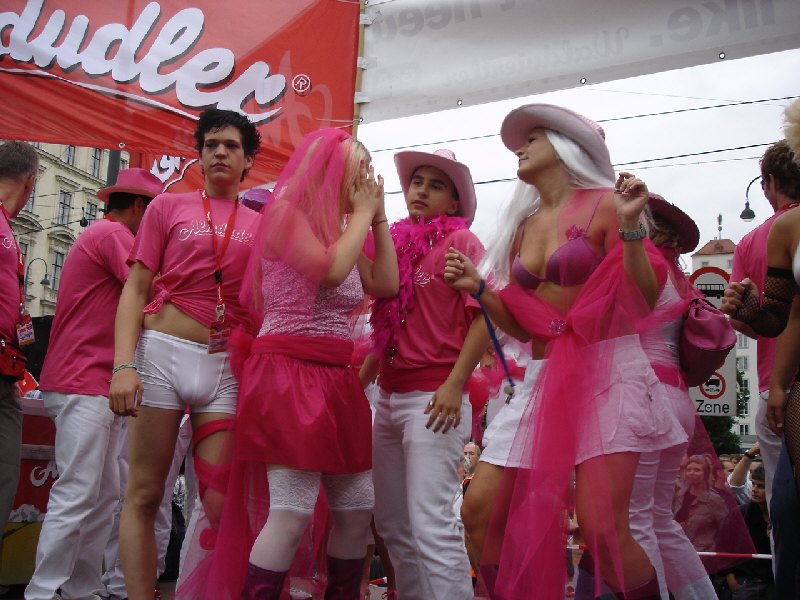
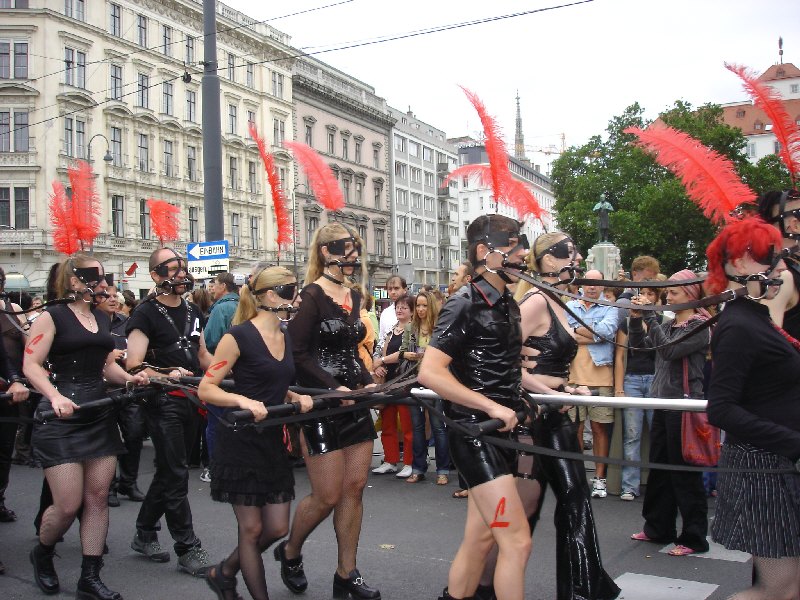
There were great costumes as usual.


Body paints, and innovative advertising.
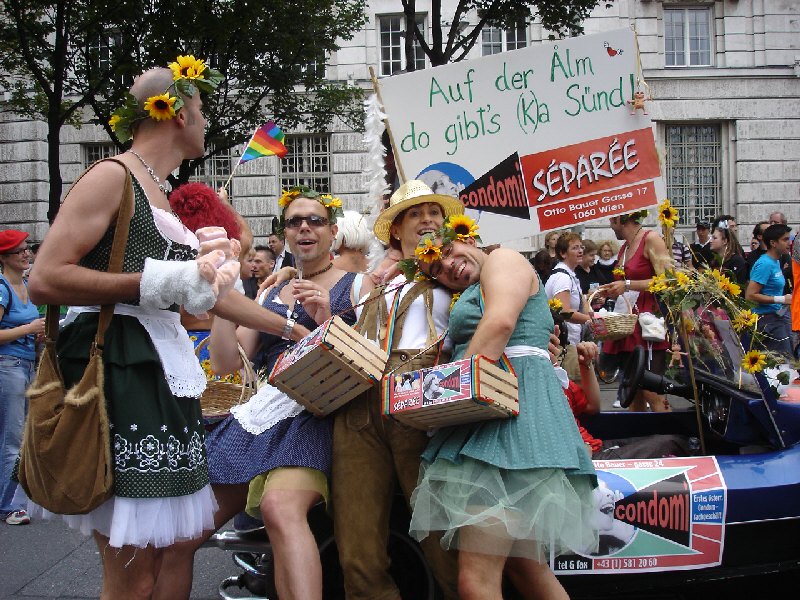
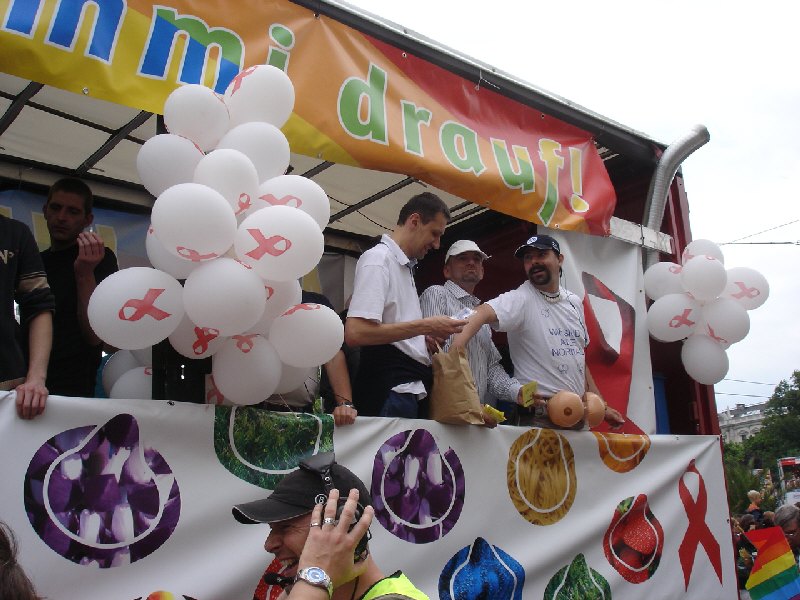
The AIDS-Hilfe distributed free condoms.


There was a float from Salzburg where the guys and girls dressed in Austrian costumes were dancing to traditional music.


And of course there were quite a few cute guys around, on the floats and on the streets.


Clovis and Michael left around 5 pm when we were near the Rathausplatz, as they were yet to do their weekend grocery shopping. Almost immediately afterwards, I saw Marcus and we walked along for the rest of the way. When I was near the Hofburg, Vijay called as he was also near there, and we finally found each other. Daniel didn't want to come as one of his aunts had died and he wasn't in the mood, and usually he keeps away from things like this anyway.

We watched the parade end and went to Heldenplatz where there was a huge crowd and a lot of singing and dancing. We met Josef, a guy I had talked to and met earlier.
Clark had called to ask where I was. It was stupid, because I had contacted most of my gay friends before and tried to see if we could all go to the parade together. I had met Clark on Thursday at the theatre group, but since he stayed back after I left, I didn't get around to discussing it with him, and later forgot to call him. It was a shame because Thomas was working, and so Clark was all alone at the parade. The stupid guy didn't call me earlier either. Well, he went back soon after I met Vijay as he didn't know that there was a lot of post-parade stuff going on in Heldenplatz.
We sms-ed back and forth and I persuaded him (and Thomas) to come to the Heldenplatz, but after an hour.
Vijay wanted to leave, and I went with him to his place because I needed to pee (I didn't realize that there were several temporary toilets in Heldenplatz for the occasion).
So we went to his place, I chatted a bit with Daniel who was watching football and then went back to Heldenplatz, which by now wasn't as crowded anymore.
Clark and Thomas arrived soon, and they were hungry, so we went to Cafe Berg for dinner.

Clark wanted to go clubbing, at WUK, and asking Leo's friends who were also in Berg, we figured that WUK was also the only place one could go for gay clubbing that evening. So after a delcious meal (chicken breast stuffed with pesto) at Cafe Berg (actually it was the first time I ate there) and a few drinks, we walked down to the WUK.

There were two or three parallel events going on-- one of them was the Homooriental that I usually enjoy, with Eastern music (mainly Balkan and Turkish, probably Arabic, rarely Indian/Bollywood), but this was in a small room, and the other more crowded room with what I was told was House music. It was really crowded and hot, nevertheless it was fun.
I even saw straight guys from the institute, Ruben from the lab (I don't think he saw me) and Lionel from the Wagner lab (he saw me, and said hello, but dunno whether he caught on that I might be gay!). Clark and Thomas left at around 2 am, I stayed on for a couple of hours more (yes!).

But yes, I went back alone. Not that there weren't people interested, or interesting people, but I realize that I don't know how to pull.

Read More...

Wednesday, June 14, 2006

Off to Paris!!!

I have lived in Europe for 7.5 years now, but never been to Paris before. As a kid, I used to gulp up Alexandre Dumas' novels. Guy de Maupassant has always been one of my favourite short story writers. I was introduced to Science Fiction (although I am not a big fan of the genre) by Jules Verne. I have read Balzac, Hugo, Flaubert, Gide. All in translation of course. The only place in France I have been to is Strasbourg, where the local dialect is very similar to German (although they usually hate to admit that). But I have never been to Paris. Not that I don't want to, but because I have always been scared of the French language and the way one never knows how to pronounce a word. What to pronounce and what not to.

For example, the "ll" Marseilles is not pronounced as "l", but the ones in Villepin and Gaulle are pronounced.

Of course everybody has told me that Paris is very touristy, and I won't have a problem. In fact I am staying with locals from Couchsurfing and Hospitality Club, the brilliant organizations which will make life so much easier.
Nevertheless...
Funnily enough, I wasn't nervous when I visited Italy, Spain or Greece.
I even called up my friend Fabien (who is French, but not from Paris) in the morning and had almost an hour's conversation and he trying to convince me that it'll be good fun. I know it will be. I know there are millions of tourists in Paris every year who don't speak any French. I know I'll have my hosts. But I am still nervous!

I'll be in Paris from today evening until the 25th. In between, I'll stay for two days in Tours and visit a few of the famous chateaux of the Loire valley. and I of course plan to make a day trip to Versailles (another place where "ll" is not pronounced!).
I will try to update my travelogue, but I don't know how often I will have access to the internet.

This is a common post for this blog and also my travelogue.

Read More...

Saturday, June 10, 2006

Blogaddiction and other addictions

I get addicted to different things at different points of my life. Fortunately I don't smoke, don't like alcohol and have no curiousity about drugs, so no harm done to my physical health. Ok, I shouldn't be in a hurry to claim that last last bit... I do wear glasses...

Reading
My very first and long-lasting addiction was books, stories.
It was probably introduced to me by my grandmother who used to read to a toddler-me every evening. There used to be a stupid story about a pet hen surprising its kid owner by laying eggs "magic", and I used to love this story. This one had to be read to me every evening apart from another story. I why my grandma didn't tear off her hair in frustration. One of my earliest memories is of throwing a tantrum because she couldn't read to me since we had visitors.
But the main "credit" for my reading addiction goes to my grandfather's cousin who had remained a bachelor and used to dote on us kids. He used to bring us books and read to us very regularly. Nowadays I don't read books all that much, but do read a bit during bus or train journeys.
I have been wearing glasses since I was 10 years old, and I believe my reading addiction is responsible for that.

People
Once in a while I also get addicted to particular people, that of course usually means that I have developed a crush, or more often that I am in love and cannot have enough of that person. Most often an "addiction" means I overdo it and manage to push them away. But that is a topic for a separate post someday.

Internet
Since quite a few years, I have seen myself getting addicted to the internet. And that is certainly not good, as I browse aimlessly when I should be working or doing other important things. This is something I really have to bring in control.

Blogs
A related addiction that I can sense is in the process of development is reading people's blogs. I have a weird way of doing that. When I like a blog, I often go back to the very first entry and read through all the posts sequentially. Especially if it is a personal blog like a diary, not if it is a news blog. Crazy, isn't it?
I first discovered a blog when I was living in Heidelberg, and I came across Trey's blog. He was a postdoc at my institute (whom I didn't yet know, and had never come across). His blog was mainly about how he and his partner (now husband-- they were married last year thanks to SF mayor Gavin Newsom) had adopted their daughter and he continues to blog about bringing her up and his thoughts about various issues. Soon after discovering the blog, I contacted Trey and walked down a floor to meet him. Later on I met Guy and Emma too. In many ways, theirs is an ideal family for me, and it is nice to keep track of Emma's growing up since we both moved-- I to Vienna and they to San Francisco.

Another parenting blog I had found through Trey's blog was about a former stay-at-home father whose daughter is already a teenager, and his son is about to be one. I guess since both his children read his blog now, he can't be very straightforward any more lest they take offence and so his blog is mostly a reminiscene of stories of when they were younger.

A blog I discovered a couple of years ago through a website was of an American guy who lives in Vienna. I have never met him, although we have had long interesting discussions. What I fascinated me was that many of his inner thought processes and insecurities etc are very much like what used to be me.
From the same website, I recently came across Prashant's blog, and it is interesting to read about another Indian living in Europe (in his case, Paris).

I had also discovered Metroblogging Vienna, a group blog which has interesting news, observations and stories about Vienna, from different perspectives.

While looking browsing through profiles of Couchsurfers in Paris because of my impending visit, I came across Justin's and Sam's blogs. Justin is an American theatre actor living in Paris, and his writing is delightful and fascinating. As I once commented while checking whether he could host me during my visit, if he "is half as good an actor as [he is] a writer, [he] must be very good indeed!" He won't be able to host me during my visit, but I hope to meet him for a drink. Unfortunately he has not been updating his blog since a long long time. Sam is a British kid who has just finished a course in Paris and will be going back to the UK. It is a pity that he will be away during most of my visit to Paris, and so we probably won't be able to meet up.

Recently, since the reservation issue has come up, I have been commenting on other blogs, and going to blogs of people whose comments are interesting, and through their blogs discovering other blogs. A very good blog that discusses various social and other issues is Indianwriting, and although I don't always agree with what she says, it is always a fascinating read. A blog that I am hooked to is now is called Random Thoughts of a Demented Mind, by a bong with his very hilarious of discussing various issues pertaining to India. Other blogs I have bookmarked include that of a gay guy from Bombay, has achieved proficiency in both German and French simultaneously in less than two (?) years, and also a blog in Hindi that I have bookmarked but am yet to read.

On Thursday, while I was supposed to be preparing for my progress report for the next day, I discovered another parenting blog of a professor of Economics, Lisa Giddings, who writes about her life with her partner and their (biologically the latter's) daughter, Maggie and a younger son (I haven't reached his birth yet). I had clicked on this blog from a random list that appears every day from his collection of blogs, but since it was a random list and I had not bookmarked it, I lost it on Friday (and read the whole of another lesbian parenting blog last night), but rediscovered it again today. I like the way she (actually the other one as well) uses pseudonyms and abbreviations for refering to people, like "BioMom" for her partner and the biological mother of their daughter and "FYO" (Four Year Old), the daughter etc. Considering that she blogs quite regularly, I haven't even reached half way yet, but it is a delightful read.

Now how do I get any thing else done, if I really keep track of so many lives every day...

Read More...

Sunday, June 04, 2006

Reservation in India: a points-based system and alternate viewpoints

I can't help it. Reservation (see my original post on this issue for a background) is probably one of the most talked about issues today in India, and hence this is already my third post on the issue in the 10 posts I have made since I started my blog. Browsing Indian blogs, I came across several interesting articles and ideas. The most interesting among them is from Anshuman Ghosh from Delhi/Hyderabad. He agrees with the need for reservations for weaker sections of the Indian society, but proposes a points-based system that gives preferences to people who really need affirmative action as opposed to someone who has already benefitted from this and should no longer require special consideration.

Quoting from his blog:
The way the Graded Points Based Reservation system is supposed to work is -

1) Extent of reservation will be calculated for each individual - just cause you are from a XYZ caste WONT let you in, as it does today
(This is a point against the present system, and in favour of Graded Points System)

2) If you are from a "backward caste" : you get ___ points.
The number of points you get in this clause will depend on which of the backward caste you are from. Aka, to what extent are you the minority. The idea is that minority is given some credit at least, but thats not the sole criteria.

3) Parents are illiterate : you get ____ points
Graduate parents ? You DONT get points under this clause.

4) You are poor (based on annual income of family etc) : you get ___ points
Parents earn lacs ? Affluent family ? You DONT get any points under this clause.
[1 lac/lakh = 100,000 -A.S.]

5) After the total points are calculated, the amount of concession in marks will also be decided on the basis of points (deficit) you have accrued.
This will also ensure that not all get the same 'help', cause the needy need more.
I really like this idea. If this is coupled with good grass-root level education and opportunities-- schools, good teachers, legal and social encouragement to send children to schools, generous scholarships and fellowships, special coaching if required, etc-- this might get rid of our social inequities in no time. This scheme could also include poor people from upper castes (with appropriate points deducted if necessary) and that would immediately get rid of the valid current concerns. In fact if all these were taken together and implemented over a limited period of time (say a decade or two), I might even support 49.5% reservation. But of course the fact remains whether reservation can achieve something. We don't know whether 22.5% reservation for the last 59 years has been able to achieve social parity for SC/STs.


Other interesting articles in the context of reservation:

1. Sam Pitroda, the head of the Knowledge Commission appointed by the Prime Minister strongly opposed the proposed increase of reservation to 49.5%. Here is an interview.

2. Puspa Bhargava, a member of the Knowledge Commission was one of the two dissenters who conditionally supported the proposed increase in reserved seats. Dr. Bhargava was the founder and former director of the Centre for Cellular and Molecular Biology (CCMB). In this interview he supports the increase in reserved seats but opposes the "creamy layer" availing the benefits of reservation. He also proposes an increase in the number of seats in general, and it might have been his idea that the government has jumped upon now to resolve the issue. He also suggests a time frame after which the number of reserved seats will be gradually decreased, a suggestion which I am sure will not be heeded by politicians. Interestingly enough, he also suggests setting up 400,000 high schools across India (and says that Central Schools/Kendriya Vidyalayas are among the best run schools in India-- dunno what his source is, but yay!) so as to make reservations unnecessary. I, and I am sure everybody else other than the politicians, would agree completely with him on the last point.

Interestingly, I noticed that one of the comments on the interview is from Sohan Modak (or someone claiming to be him). Prof. Modak very effectively headed the Department of Zoology at the University of Pune, and brought it to excellence. He had also made sure that it was one of the first places in India where a Masters in Biotechnology was instituted. Unfortunately politics among professors (most of whom he had brought in) spoiled the department and Biotechnology split up from Zoology (I was in one of the first batches that suffered because of this). Modak was a great teacher, albeit a very pompous one, and a decent scientist particularly in his younger days). I quote his comments:
Subject: Dr. P.M. Bhargava on the issue of reservations
Whuile there is always the problem of haves and haves not, Bhargawa's comments are far more insidious than they appear. He, like Manmohan Singh, have missed the point by ignoring what do the students in the general category have to fight to get admission in an institution of higher learning than those who are awarded direct entry albeit without having learnt 60 % of their academic material! Whaty a death nail for the National Knowledge commission! PMB's comments are at best assinine as he has never really been a teacher, nor a saviour of reserved classes when practicing employment practices when he directed the laboratory. Did he really practice affirmative action in hiring personnel ? I guess he enjoys the same power play that Arjun singh does! It is really unfortunate that neither PMB, nor his cohorts, have done much to generate the greatest need of India, and that is to provide good teachers without whom the country is doomed. You can take the reservations to 90%, but who will teach? Not PMBs from their high pedestals. I have already asked NKC to help me understand what is knowledge, but none have cared (or, dared) to reply. well, at least not yet!
-Prof. sohan Modak, Pune.
3. A very thought-provoking article by Siddharth Varadarajan shows how castism still exists even in institutes of higher education, how the media is often one sided, and why there should be reservations. I found the article via this excellent blog, indianwriting.

Update 5 June 06 1.49am :
4. Yet another thought-provoking article via indianwriting has Yogendra Yadav discussing statistics of backward castes (OBCs- mainly Shudras in the Varna system). According to the article, even going by the minimum figure, the percentage of OBCs in the population would be around 36%, which is more than the 27% which the government wants to reserve for them. He claims that the non-SC/ST/OBC, i.e., the rest of the population is 33%, which is somewhat difficult for to digest.
Nevertheless, I think improving conditions at the grassroot levels (schools, absolutely compulsory education, good and non-truant teachers, generous scholarships, extra coaching if required and the like) are more important for achieving social equality than reserving 49.5% seats in IITs.
How would people who don't have the grassroot stuff that I described above compete for the IITs with or without reservations? That would only bring down the standards of higher education. And again will reservation achieve anything; has it achieved anything significant for the SC/STs in the decades since independence?

Read More...

Genetically Modified Organisms

I was checking out discussion groups in CouchSurfing (that reminds me, I really have to write the inaugaral post about CouchSurfing and Hospitality Club on my travelogue), and saw this group called "Protecting the Environment for a healthier tomorrow". They'd had a very one-sided discussion on Transgenic Crops-- as is usually the case, such groups are filled with people who care for the environment, but most of their "knowledge" comes from scare-mongering environment groups, like Greenpeace. Don't get me wrong, Greenpeace does a tremendous amount of great work, but I absolutely don't agree with their campaign against everything GMO. A couple of years ago it had these imbecile posters all over Vienna that translates to "Is Your Milk Changed? -Against Transgenics [German: Gentechnik]". That is stupid scare-mongering which is amazingly successful in Europe. At the other end we have Monsanto et al. that give an equally one sided view, that no one can trust.

The problem is that there are very few people who look at both sides and are in between. Scientists and Geneticists, who know what is happening (but do not have vested interests), and who may well be listened to by the public, prefer to remain within their ivory towers and don't to speak to the public. Anyways, I joined the group and posted a rather long write up. Probably too long... but hopefully someone in the group will read it. Let's see whether I manage to restart the discussion.

Background: The discussion was started by the moderator in the context of Golden Rice. This rice produces beta-carotene in the part that we eat, its endosperm (it is normally only produced in green tissues). Since a lot of children in poor rice-based societies suffer from blindness because of Vitamin A deficiency, Golden Rice might be a good way to prevent it.
I reproduce my write-up below with minor editing.
[It was written in a hurry, at one sitting, and perhaps later I should research it more and write a better article. But this should do for now. If you are a biologist, you might find things a bit over-simplified, but remember it was written for non-biologists.]

My problem with the debate (as with most issues of environment) is that people on both sides refuse to listen to the opposing side. In this forum, the discussion has been mainly to oppose transgenics, so I'll attempt to go towards the other side. A blanket "Genetically modified food/animals/plants is bad" as propagated by Greenpeace and others is plain crazy. Just as it would be crazy to assume that Monsanto and others are saints on earth.

What is GM technology?
It refers to modification of genetic material of organisms in the laboratory. Remember, right from the beginning of civilization farmers have been crossing plants and animals to obtain better characteristics. This used to take several decades, but now can be done in the laboratory in a few months. None of the food you eat is what used to grow in wild. They are all products of crossing by farmers through centuries.

Common products of GM technology
I bet you have heard of Insulin. It is given to people who suffer from certain forms of diabetes. All insulin for pharmaceutical purposes is only produced from genetically engineered bacteria, and this is the safest possible method. Genetically engineered Insulin is historical as it was the first such case, but now many medicines, hormones, vaccines etc are produced by genetic engineering.
So, please don't put a blanket horror sign on genetic engineering or transgenic technology.

Fine, that was bacteria, what about plants and animals?
Apart from time and convenience there is another huge difference between crossing plants and animals as farmers did, and what can be done in the laboratory. And this is what most the fuss is about. Famers can cross only (closely) related plants, or in case of animals of the same species (exceptions being mules). However, in the laboratory, one could theoretically express any gene from anywhere in a plant or animal, something not possible by farmers. And one can use diverse sources-- express a plant protein in animals or visa versa. For example, there was a recent report of a very useful goat that produces human anti-thrombin (required for blood coagulation) in its milk. Until now this protein used to be extracted from human blood, and given the number of diseases, this is no longer a safe option.
Of course these goats are only for pharmaceutical companies, their milk is not for making cheese. This is an example of what can be done.
The beta-carotene from the main example, again, is something that is present in tomatoes and carrots that give them their red colour. They can be put in rice. Why should this be any problem at all? If you can eat beta-carotene in tomatoes and carrots, what is the problem in eating them in rice?

Real Problems
No, I am not naive enough to say that all transgenics are good and we should all blindly approve of them. There are potential problems and caveats.

a) Environmental: Say a company wants to produce a plant that has a huge yield, but its seeds kill themselves (so that the farmer has to come back to the company to buy these seeds). That might be dangerous to the environment, as these genes might escape through natural sources (viruses and other pathogens, pollen etc) and create havoc to the flora.
There are several such real life examples. But again, not all such cases are harmful, and each case is different and should be studied on merits of its own.

b) Health: In many cases, because of our incomplete knowledge, it is difficult to predict whether expressing a foreign protein, might affect other aspects of the metabolism of the plants and animals, making them unsafe for consumption. This is indeed a huge caveat and justify the cautious approach of many countries to GM food. But extensive tests should be able to find out whether there is a risk in a particular case.

Conclusion
I hope I have been able to show (if not convince) you that transgenics are not all dangerous. Some of them are indeed cause for concern, but each case should be studied on its own merit. The safety of individual cases should be tested really rigourously, and after they pass these tests, they should be allowed to be used.
If babies of poor countries are going blind because of the lack of beta-carotene, and rice that expresses it (and has been rigorously tested to be safe) can be provided to them, I think it would be extremely selfish of us to sit in our armchairs and pontificate that we are against GM food and we won't allow this.

Have we forgotten Marie Antoinette's comment about cakes instead of bread?


Disclaimer: I am a Geneticist, I use genetic engineering techniques every day in the lab, but in basic research only. I don't make transgenic food, or animals that produce stuff in their milk, or clone animals or the like. And I am not associated with any commercial company, although our institute is funded by one.

Read More...

Saturday, June 03, 2006

An unexpected compliment

I had almost forgotten about Leonie's flattering compliment. On Tuesday, when Ramesh was here for the siRNA conference, and we were having dinner upstairs at the cafeteria, two German guys were sitting next to us. One of these was a young group leader in Ramesh's current institute, and when he had been introduced before his talk, I had heard that he had done his postdoc in Heidelberg. So I enquired about people I knew from that lab and he asked where I had worked. As soon as I said EMBL and Jürg, the other German guy sitting next to me introduced himself as Marc (Leonie's boyfriend who works in Bielefeld, I hadn't gone for his talk at the conference) and that Leonie had told him about me being in Anton's group. Later when Leonie came and I told her that I'd met Marc, she said that she had told him about "how much fun the joint lab-meetings [progress-reports] are because of [my] contributions". Wow! That was nice to hear!!

We have been having weekly joint progress reports with her group since more than a month, and from this week we started an alternate-weekly joint Epigenetics Journal Club as well. It is true that right from the beginning, I have been liberal with my questions and comments in our own progress reports, and apart from Anton, I probably am the most vocal in these. Now that we have them with her group, I continue my barrage of questions, comments and interruptions because in our group I am the most familiar with their area of research as it was my own during my PhD.

Nevertheless, I was quite taken aback by her compliment and also that she had actually told this even to Marc so that he knew all about me!


In a related development, during the Epigenetics Journal Club today, she jokingly suggested that I participate in their Polycomb Journal Club, and I did sign up. It'll take up quite a bit of my time, but I think it will be very useful and I'll enjoy it. But it starts at 9am every wednesday, so I have to be in the institute well before that...

Read More...

Wednesday, May 31, 2006

At long last, Kalam gets going...

President APJ Abdul Kalam has returned the office-of-profit bill to the Parliament for reconsideration. Kalam seems to finally have woken up to his duties as the President of India.

The office-of-profit issue: Jaya Bachchan
The Constitution of India bars the Members of Parliament from holding "offices-of-profit". The usefulness of this law is debatable in itself, but let's not go into that. I think this law had by and large been ignored, until very recently. Many MPs were in various organizations and while they may not have been drawing a salary, these posts would legally be classed as offices-of-profit. They would of course be enjoying perks of these positions.
The matter came into the forefront when Jaya Bachchan of the Samajwadi Party was reported to the Election Commission by someone in the Congress for being the Chairperson of the Uttar Pradesh Film Development Corporation, a post that as a reputed actress, she is fully qualified to hold, but the position of course also includes cabinet rank perks. After its investigations, the Election Commission recommended her disqualification as a member of the Rajya Sabha and after consulting legal experts, the President accepted the recommendation on March 17. Jaya had challenged it in the Supreme Court, but her petition was dismissed.

Quoting from an article on the net, under Article 103 of the Constitution, ``if any question arises as to whether a Member of either House of Parliament has become subject to any of the disqualifications mentioned in Article 102, the question shall be referred for the decision of the President and his decision shall be final. Before giving any decision on any such question, the President shall obtain the opinion of the Election Commission and shall act according to such opinion."

The office-of-profit issue: "some animals are more equal than others"
Comically enough, it turned out that many MPs held offices of profit, including the Speaker of Lok Sabha, Somnath Chatterjee, and Sonia Gandhi, the most powerful woman (person?) of India. Sonia, the president of the Congress Party who had in a political masterstroke declined to be the Prime Minister was a member of the Lok Sabha as also the chairperson of the National Advisory Council, the Rajiv Gandhi Foundation, Indira Gandhi Memorial Trust and Jawahar Bhavan Trust; and was a member of a horde of other organizations. She resigned from all these and her Lok Sabha seat on and around March 23. This was immediately hailed by the Congress sycophants as yet another example of her sacrifices. She promptly stood for by-elections from her constituency and was re-elected to the Lok Sabha within seven weeks of her resignation.

Backdoor bill
Sonia Gandhi "sacrifices", but what about the Speaker, and the other important MPs from the Congress Party and its allies? A bill exempting 46 posts that these members held (and even those held by some prominent MPs in the opposition) from the purview of the office of profit was introduced into the Parliament on May 15 and was passed on May 16.

Yesterday, this bill was returned to the Parliament for reconsideration by President Kalam.

The President of India
The President of India has to act on the advice of the Prime Minister and his Cabinet on almost every occasion. The exception is of course inviting a party to form the government after elections, and this is especially relevant when no party gets a clear majority in the Parliament. Similarly, when a government loses confidence of the Parliament, he can decide whether to dissolve the Lok Sabha and call for elections, or to invite another party to form the government. The President can also return a bill or ordinance to the Parliament or the goverment, respectively, for reconsideration, but is constitutionally bound to sign it if it is sent back to him. Hence returning such a document has more of a symbolic value, but it creates news in the country and this is a way the President can register his dissent in an important issue. The President can also demand an explanation from the Prime Minister issues, and again this makes news. The late former President KR Narayanan has been one of the few Presidents in recent times (certainly since I have been following politics) who had used these nominal powers to the maximum. The Vajpayee government had recommended the dismissal of a State government on two occasions, and on both occasions President Narayanan had returned these recommendations for reconsideration causing considerable public debate, and consequently the government had not dared to send them back to him. Narayanan also crossed swords with the government on the Gujarat riots (as he later claimed after retirement) and a perhaps unwarranted banquet speech during Bill Clinton's visit. In my opinion KR Narayanan set new standards of responsibility for the office of the President of India.

President Kalam
Most parties wanted a second term for President Narayanan, but for obvious reasons the Vajpayee government didn't. It looked like there would be a confrontation for the election of the 11th President of India, when Vajpayee came up with his trump card-- APJ Abdul Kalam's name was proposed.
Kalam was associated with ISRO and DRDO (later as DRDO Director), and also served as the Principal Scientific Advisor to the Indian government. He has been associated with the development of the Satellite Launch Vehicle. It was during his directorship that DRDO's Agni and Prithvi missiles were developed. And it was during his tenure as Principal Scientific Advisor, that the Pokhran tests were carried out. He has also received the Padma Bhushan (1981), Padma Vibhushan (1990) and the highest Indian civilian award, the Bharat Ratna (1997). He was already a popular figure, and with his autobiography, Wings of Fire (1999), he became even more popular. Thus, apart from a token candidate from the communist parties, Kalam was elected unopposed as the President of India in 2002.
President Kalam continues to enjoy widespread popularity in the country especially because of his insistence on interacting with children and younger people and motivating them on all available opportunities.

Failure of President Kalam
However praiseworthy his striving to nurture the minds of young citizens may be, he has seemed to be failing in his responsiblities as the President of India. Last year, the Bihar electoral results did not give a majority to Railway Minister Lalu Yadav's Janata Dal, and there seemed to be an impasse with no political party or coalition having majority. Buta Singh as the Governer of Bihar recommended dissolution of the unconvened Assembly and imposition of President's Rule until fresh elections were held. President Kalam was in Russia at that time (almost exactly a year ago), and apparently was woken up in the middle of the night and asked to sign the order at the recommendation of the Cabinet. Unlike his predecessor whose actions I have discussed above, he did not even ask to wait until morning, much less seek legal advice. The Supreme Court later ruled that this dissolution had been illegal. There is an excellent article on this by my favourite columnist, MJ Akbar (unfortunately this article is not archived in Asian Age where MJ Akbar originally published this).

Concluding Remarks: the Office-of-Profit Bill and President Kalam
The issue of the office of profit is really trivial, and shows nothing more than the hypocrisy of the political class. Why shouldn't certain MPs hold offices especially the ones they have expertise in, like Jaya Bachchan in Film Development, Dr. Kasturirangan as advisor to the ISRO, or Sonia Gandhi as the chairperson of the National Advisory Council? The way it was handled shows the petty vindictiveness of Sonia towards the Bachchans. But the issue in itself certainly isn't worth the ruckus it has created. Nevertheless, by returning the office of profit bill for reconsideration, President Kalam has shown that he has finally become aware of the responsibilities of the office of the President of India.

Tivia on "Dr." Kalam
When Kalam's candidature was announced, one of his former colleagues had anonymously remarked that he was "a scientist among politicians, and a politician among scientists". On different occasions recently, I had quoted this remark to two extremely senior Indian scientists (Physics and Engineering, respectively) who would be in the know about Kalam, and they mentioned that this comment would be very fitting. One of them in fact expressed doubts about his actual scientific contribution (not his managerial contribution though) in the high profile projects he has been associated with. This person also expressed resentment that although Kalam doesn't hold a PhD, he makes absolutely no effort to correct all and sundry calling him "Dr. Kalam" (Kalam has indeed been conferred numerous honorary doctorates, but these cannot be used and he certainly should know that). I had heard this (that he doesn't have a PhD) before in the context that after he retired as the Principal Scientific Advisor to the Indian government, he wanted a professorship at the IISc, but they could (did?) not give it to him because he did not have a PhD... also reported in
this article. If it was only this reason, I don't think it was the right thing to do, but having heard the opinions of the scientists I mentioned above, there might well be proper reasons pertaining to actual scientific competence. I would add however, that Kalam and "Balki" are supposedly quite close and "Balki" certainly is a very respected and comptent scientist at IISc.

Read More...

Meeting an old friend

I met Ramesh after 6 1/2 years! The last I had met him was in Berne in October 1999. I had gone to Zurich for a conference, and afterwards took a train to Berne and spent the weekend with him.

I had seen the poster announcing the symposium in IMBA on si/miRNA, and Ramesh's name as a speaker quite a while ago. Since we haven't really been in touch, I googled for his email address last week and thereby discovered that he was joining EMBL Grenoble as a group leader!!!! Wowowowowow!!! I knew he had been doing very well and I had seen (although I am ashamed to admit, not read) his paper in Science and also that this was judged the best paper of that year by the RNA society (I think). But this was terrific. As far as I know he is the first of my friends and contemporaries to get such a job. Well ok, Uma did join NCBS as a group leader last year, nevertheless this is EMBL (albeit Grenoble, not Heidelberg)! And Ramesh will be the only Indian group leader (and the only other Asian group leader other than Asifa Akhtar who is Pakistani) in EMBL and its outstations. Of course I also found his email address and dashed off an email.

The conference was yesterday and today (well given the time now, it was day-before-yesterday and yesterday :-)), and Ramesh's was the first talk after the Plenary Lecture (Steve Cohen), and was one of the two best ones (not counting Javier's but he was the host and I didn't attend his), the other was Antonio Giraldez whom I used to know at EMBL.

It was great catching up with him. I did know about his French wife (Emilie -sp?) and that they had a daughter (Alina? Elina?) who is now 18 months. They will be moving from Basel to Grenoble in the beginning of July. That's exciting. Yesterday we didn't really get much time to talk, but today we had lunch (with other people and so talking in English) and dinner (I gatecrashed into their conference dinner at our cafeteria) and soon afterwards we came to the pub opposite my building (he's been put up in the Mercure-Biedermeier hotel nearby) and chatted until 12:30am.

Ramesh used to be one of the funniest guys I've known, and he still retains his excellent sense of humour. He's lost more hair, and surprising has a lot of grey hair, but still looks the same. He seems to have lost the mallu touch in his accent when he speaks English, but retains it completely when he speaks Hindi. It was really great to talk about old times, catch up, and speculate about the future.

Read More...

Monday, May 29, 2006

Reservation Politics: an interview with Arjun Singh

Arjun Singh seems to have an obstinate determination that only he knows what is the best in the reservation issue. Logic and sense don't seem to work with him as evidenced in an interview with Karan Thapar (via DynamiX notes, a community blog that I chanced upon today). [Check the post of May 17, 2006 for the background]

Excerpts (actually, most of it) :

Parliament has decided, so it will happen

Karan Thapar:Most of the people would accept that steps are necessary to help the OBCs gain greater access to higher education. The real question is: Why do you believe that reservations is the best way of doing this?
Arjun Singh: I wouldn't like to say much more on this because these are decisions that are taken not by individuals alone. And in this case, the entire Parliament of this country - almost with rare unanimity - has decided to take this decision.
Karan Thapar: Except that Parliament is not infallible. In the Emergency, when it amended the Constitution, it was clearly wrong, it had to reverse its own amendments. So, the question arises: Why does Parliament believe that the reservation is the right way of helping the OBCs?
Arjun Singh: Nobody is infallible. But Parliament is Supreme and at least I, as a Member of Parliament, cannot but accept the supremacy of Parliament.
Karan Thapar: No doubt Parliament is supreme, but the Constitutional amendment that gives you your authorities actually enabling amendment, it is not a compulsory requirement. Secondly, the language of the amendment does not talk about reservations, the language talks about any provision by law for advancement of socially and educationally backward classes. So, you could have chosen anything other than reservations, why reservations?
Arjun Singh: Because as I said, that was the 'will and desire of the Parliament'.


No matter what data you show, he won't believe it

Karan Thapar: In which case, lets ask a few basic questions. We are talking about the reservations for the OBCs in particular. Do you know what percentage of the Indian population is OBC? Mandal puts it at 52 per cent, the National Sample Survey Organisation (NSSO) at 32 per cent, the National Family and Health Survey at 29.8 per cent, which is the correct figure?
Arjun Singh: I think that should be decided by people who are more knowledgeable. But the point is that the OBCs form a fairly sizeable percentage of our population.
Karan Thapar: No doubt, but the reason why it is important to know 'what percentage' they form is that if you are going to have reservations for them, then you must know what percentage of the population they are, otherwise you don't know whether they are already adequately catered to in higher educational institutions or not.
Arjun Singh: That is obvious - they are not.
Karan Thapar: Why is it obvious?
Arjun Singh: Obvious because it is something which we all see.
Karan Thapar: Except for the fact that the NSSO, which is a government appointed body, has actually in its research in 1999 - which is the most latest research shown - that 23.5 per cent of all university seats are already with the OBCs. And that is just 8.5 per cent less than what the NSSO believes is the OBC share of the population. So, for a difference of 8 per cent, would reservations be the right way of making up the difference?
Arjun Singh: I wouldn't like to go behind all this because, as I said, Parliament has taken a view and it has taken a decision, I am a servant of Parliament and I will only implement.
Karan Thapar: Absolutely, Parliament has taken a view, I grant it. But what people question is the simple fact - Is there a need for reservations? If you don't know what percentage of the country is OBC and if, furthermore, the NSSO is correct in pointing out that already 23.5 per cent of the college seats are with the OBC, then you don't have a case in terms of need.
Arjun Singh: College seats, I don't know.
Karan Thapar: According to the NSSO - which is a government appointed body - 23.5 per cent of the college seats are already with the OBCs.
Arjun Singh: What do you mean by college seats?
Karan Thapar: University seats, seats of higher education.
Arjun Singh: Well, I don't know I have not come across that so far.
Karan Thapar: So, when critics say to you that you don't have a case for reservation in terms of need, what do you say to them?
Arjun Singh: I have said what I had to say and the point is that that is not an issue for us to now debate.
Karan Thapar: You mean the chapter is now closed?
Arjun Singh: The decision has been taken.
Karan Thapar: Regardless of whether there is a need or not, the decision is taken and it is a closed chapter.
Arjun Singh: So far as I can see, it is a closed chapter and that is why I have to implement what all Parliament has said.

Karan Thapar: Minister, it is not just in terms of 'need' that your critics question the decision to have reservation for OBCs in higher education. More importantly, they question whether reservations themselves are efficacious and can work.
For example, a study done by the IITs themselves shows that 50 per cent of the IIT seats for the SCs and STs remain vacant, and for the remaining 50 per cent, 25 per cent are the candidates who even after six years fail to get their degrees. So, clearly, in their case, reservations are not working.
Arjun Singh: I would only say that on this issue, it would not be correct to go by all these figures that have been paraded.
Karan Thapar: You mean the IIT figures themselves could be dubious?
Arjun Singh: Not dubious, but I think that is not the last word.
Karan Thapar: All right, maybe the IIT may not be the last word, let me then quote to you the report of the Parliamentary Committee on the welfare for the Scheduled Castes and Scheduled Tribes - that is a Parliamentary body.
It says, that looking at the Delhi University, between 1995 and 2000, just half the seats for under-graduates at the Scheduled Castes level and just one-third of the seats for under-graduates at the Scheduled Tribes level were filled. All the others went empty, unfilled. So, again, even in Delhi University, reservations are not working.
Arjun Singh: If they are not working, it does not mean that for that reason we don't need them. There must be some other reason why they are not working and that can be certainly probed and examined. But to say that for this reason, 'no reservations need to be done' is not correct.
Karan Thapar: Fifty years after the reservations were made, statistics show, according to The Hindustan Times, that overall in India, only 16 per cent of the places in higher education are occupied by SCs and STs. The quota is 22.5 per cent, which means that only two-thirds of the quota is occupied. One-third is going waste, it is being denied to other people.
Arjun Singh: As I said, the kind of figures that have been brought out, in my perception, do not reflect the realities. Realities are something much more and, of course, there is an element of prejudice also.
Karan Thapar: But these are figures that come from a Parliamentary Committee. It can't be prejudiced; they are your own colleagues.
Arjun Singh: Parliamentary Committee has given the figures, but as to why this has not happened, that is a different matter.
Karan Thapar: I put it to you that you don't have a case for reservations in terms of need, you don't have a case for reservations in terms of their efficacy, why then, are you insisting on extending them to the OBCs?
Arjun Singh: I don't want to use that word, but I think that your argument is basically fallacious.
Karan Thapar: But it is based on all the facts available in the public domain.
Arjun Singh: Those are facts that need to be gone into with more care. What lies behind those facts, why this has not happened, that is also a fact.


Jawaharlal Nehru and reservation

Karan Thapar: Let me quote to you Jawaharlal Nehru, a man whom you personally admire enormously. On the 27th of June 1961 wrote to the Chief Ministers of the day as follows: I dislike any kind of reservations. If we go in for any kind of reservations on communal and caste basis, we will swamp the bright and able people and remain second-rate or third-rate. The moment we encourage the second-rate, we are lost. And then he adds pointedly: This way lies not only folly, but also disaster. What do you say to Jawaharlal Nehru today?
Arjun Singh: Jawaharlal Nehru was a great man in his own right and not only me, but everyone in India accept his view.
Karan Thapar: But you are just about to ignore his advice.
Arjun Singh: No. Are you aware that it was Jawaharlal Nehru who introduced the first amendment regarding OBCs?

Karan Thapar: Yes, and I am talking about Jawaharlal Nehru in 1961, when clearly he had changed his position, he said, “I dislike any kind of reservations”.
Arjun Singh: I don't think one could take Panditji's position at any point of time and then overlook what he had himself initiated.
Karan Thapar: Am I then to understand that regardless of the case that is made against reservations in terms of need, regardless of the case that has been made against reservations in terms of efficacy, regardless of the case that has been made against reservations in terms of Jawaharlal Nehru, you remain committed to extending reservations to the OBCs.
Arjun Singh: I said because that is the will of Parliament. And I think that common decisions that are taken by Parliament have to be honoured.


Logistics in the increase in the number of seats

Karan Thapar: One way forward would be to increase the total number of seats.
Arjun Singh: Yes, definitely.
Karan Thapar: But the problem is that, as the Times of India points out, we are talking of an increase of perhaps as much as 53 per cent. Given the constraints you have in terms of faculty and infrastructure, won't that order of increase dilute the quality of education?
Arjun Singh: I would only make one humble request, don't go by The Times of India and The Hindustan Times about faculty and infrastructure, because they are trying to focus on an argument which they have made.
Karan Thapar: All right, I will not go by The Times of India, let me instead go by Sukhdev Thorat, the Chairman of the UGC. He points out that today, at higher education levels - that is all universities, IITs and IIMs - there is already a 1.2 lakh vacancy number. Forty per cent of these are in teaching staff, which the IIT faculty themselves point out that they have shortages of up to 30 per cent. Given those two constraint, can you increase the number of seats?
Arjun Singh: That can be addressed and that shortage can be taken care of.
Karan Thapar: But it can't be taken care of in one swoop, it will take several years to do it.
Arjun Singh: I don't know whether it can be taken care of straightway or in stages, that is a subject to be decided.


"Creamy layer" and children of beneficiaries

Karan Thapar: The CPM says that if the reservations for the OBCs are to happen, then what is called the ‘creamy layer’ should be excluded. How do you react to that?
Arjun Singh: The ‘creamy layer’ issue has already been taken care of by the Supreme Court.
Karan Thapar: That was vis-a-vis jobs in employment, what about at the university level, should they be excluded there as well because you are suggesting that the answer is yes?
Arjun Singh: That could be possible.
Karan Thapar: It could be possible that the ‘creamy layer’ is excluded from reservations for OBCs in higher education?
Arjun Singh: It could be, but I don't know whether it would happen actually.
Karan Thapar: Many people say that if reservations for OBCs in higher education happen, then the children of beneficiaries should not be entitled to claim the same benefit.
Arjun Singh: Why?
Karan Thapar: So that there is always a shrinking base and the rate doesn't proliferate.
Arjun Singh: I don't think that that is a very logical way of looking at it.
Karan Thapar: Is that not acceptable to you?
Arjun Singh: No, it is not the logical way of looking at it.
Karan Thapar: So, with the possible exception of the creamy layer exclusion, reservation for OBCs in higher education will be almost identical to the existing reservations for SC/STs?
Arjun Singh: Except for the percentage.
Karan Thapar: Except for the percentage.
Arjun Singh: Yes.
Karan Thapar: So, in every other way, they will be identical.
Arjun Singh: Yes, in every other way.


Jumping the gun or fall guy?

Karan Thapar: Mr Arjun Singh, on the 5th of April when you first indicated that the Government was considering reservation for OBCs in higher education, was the Prime Minister in agreement that this was the right thing to do?
Arjun Singh: I think, there is a very motivated propaganda on this issue. Providing reservation to OBCs was in the public domain right from December 2005, when Parliament passed the enabling resolution.
Karan Thapar: Quite true. But had the Prime Minister specifically agreed on or before 5th of April to the idea?
Arjun Singh: Well, I am telling you it was already there. A whole Act was made, the Constitution was amended and the Prime Minister was fully aware of what this is going to mean. Actually, he had a meeting in which OBC leaders were called to convince them that this would give them the desired advantage. And they should, therefore, support this resolution. And at that meeting, he himself talked to them. Now, how do you say that he was unaware?
Karan Thapar: But were you at all aware that the Prime Minister might be in agreement with what was about to happen but might not wish it disclosed publicly at that point of time? Were you aware of that?
Arjun Singh: It was already there in public domain, that's what I am trying to tell you.
Karan Thapar: Then answer this to me. Why are members of the PMO telling journalists that Prime Minister was not consulted and that you jumped the gun?
Arjun Singh: Well, I don't know which member of the PMO you are talking about unless you name him.
Karan Thapar: Is there a conspiracy to make you the Fall Guy?
Arjun Singh: Well, I don't know whether there is one or there is not. But Fall Guys are not made in this way. And I am only doing what was manifestly clear to every one, was cleared by the party and the Prime Minister. There is no question of any personal agenda.
Karan Thapar: They say that, in fact, you brought up this issue to embarrass the Prime Minister.
Arjun Singh: Why should I embarrass the Prime Minister? I am with him. I am part of his team.
Karan Thapar: They say that you have a lingering, forgive the word, jealousy because Sonia Gandhi chose Manmohan Singh and not you as Prime Minister.
Arjun Singh: Well, that is canard which is below contempt. Only that person can say this who doesn't know what kind of respect and regard I hold for Sonia Gandhi. She is the leader. Whatever she decides is acceptable to me.
Karan Thapar: They also say that you brought this issue up because you felt that the Prime Minister had been eating into your portfolio. Part of it had gone to Renuka Chaudhury and, in fact, your new deputy minister Purandar Sridevi had taken over certain parts. This was your way of getting back.
Arjun Singh: No one was taking over any part. This is a decision which the Prime Minister makes as to who has to have what portfolio. And he asked Mrs Renuka Devi to take it and he cleared it with me first.
Karan Thapar: So there is no animus on your part?
Arjun Singh: Absolutely not.
Karan Thapar: They say that you did this because you resented the Prime Minister's popular image in the country, that this was your way of embroiling him in a dispute that will make him look not like a modern reformer but like an old-fashioned, family-hold politician instead.
Arjun Singh: Well, the Tammany Hall political stage is over. He is our Prime Minister and every decision he has taken is in the full consent with his Cabinet and I don't think there can be any blame on him.


Read More...

Sunday, May 28, 2006

Ohrwurm and Jethu's Songs

There is a word in German, that probably doesn't have an equivalent in English: Ohrwurm (literal translation: "ear worm"). It describes a condition where a song or melody sticks in the head and refuses to get out, and one has to hum/whistle it over and over all day long.

My aunt, "Jethima" had been visiting me last weekend and she had brought a few cds of my uncle's ("Jethu"'s) songs that they have released, unfortunately after his death.Jethu had been a diligent collector and later singer and teacher of folk songs from the North Bengal-Assam regions, particularly the ones sung in the tea gardens, but he had seldom recorded his songs. There used to be one gamaphone record when we were kids, but the era of gamaphone records passed, so did the record. As a result, I don't remember when I had heard Jethu's songs last, although of course I do remember some of the beautiful melodies. The cd revived those memories and some of these melodies, the jhumur songs have been going in my head all the while, in fact I must have heard the cd some 15 times during the weekend. The one that has been a real Ohrwurm since the last few days isn't on the website, but two other favourite jumurs are there, albeit in not-so-great recordings (later recordings when he was quite old, and in the case of the second case with chorus and too much orchestra) here and here. It is a pity I don't know whether or how I can load mp3s onto the blog, otherwise I'd upload my favourite ones from the cd here.

Something I had not realized when I was a kid was how beautiful some of the lyrics of some of these songs are. They talk mostly of sadness and the social conditions, but sometimes also of romance and flirting within that. The dialect is from North Bengal, or Assam, or a mixture between these two or even mixed with that of the Chotanagpur area from where coolies used to go to work in the tea gardens up there. And so I can't understand most of it. I have emailed Jethima asking her if she could send me the lyrics when she gets back to Shantiniketan, and I hope she does.

Read More...

Tuesday, May 23, 2006

Homophobia at the UN

I get these email newsletters from ILGA (International Lesbian and Gay Association). They often have interesting political information. I guess at some point I should become a member and really think of doing something, attending their conferences when they are held in Europe or the like. But I'm, after all, me, and my to-do list is as boundless as my procrastination.

Anyway, I just saw this newsletter saying that ILGA and a German LGBT organization had requested observer status at the UN, and the UN Economic and Social Council (ECOSOC)’s Committee on Non-governmental organizations rejected both applications on the same ground, proposed and supported by Iran and Sudan respectively: neither organization had "succeeded in proving it had taking sufficient measures to prevent or fight paedophilia". What an absurd and atrocious contention!

Quoting from the ILGA website:
Votes to reject LSVD and ILGA’s Europe’s applications on a proposal of Iran went as follows:
- 9 in favor (Cameroon, China, Côte d’Ivoire, Iran, Pakistan, Russian Federation, Senegal, Sudan and Zimbabwe)
- 7 against (Chile, Colombia, France, Germany, Peru, Romania and the United States)
- 2 abstentions (India and Turkey)
- 1 member not present (Cuba)

I am happy to see that India abstained. Given the homophobic Section 377 of the Indian Penal Code, I guess they couldn't have directly supported the two organizations. But I wish they would. Imagine if both India and Turkey had voted against the proposal...

Quoting again,

Germany stressed that the accusation of paedophilia was absurd against an NGO such as ILGA Europe which enjoys consultative status with the Council of Europe, receives project funding from the European Union and has spoken to the OSCE on human rights defenders.

I am happy to see India again being included in the following:

In general statements before the vote and explanations of position, the representatives of Germany, France, Chile, Romania, India and Peru, noting that during the session, applications of two NGOs addressing the same issue had been rejected, expressed concern that there seemed to be a discriminatory trend. “As homosexuality was a delicate issue, a constructive dialogue between the Committee and the NGO would have been welcome” they noted.

The article from the ILGA website can be found here.


Read More...

Wednesday, May 17, 2006

"Reservation" or Affirmative Action in India

A large number of students, especially medical students, are protesting against the government's proposed policy of increasing the number of reserved seats in educational institutes to 50%. These protests are really muted compared to those in 1990 against the implementation of similar recommendations of the Mandal Commission. One of the reasons of the fall of the then government is often attributed to their obstinacy in implementing these recommendations (although I don't think that is true... the BJP withdrew external support from the government after Advani was arrested in UP). Now we have a repeat perfomance 16 years later. The government, at least the minister for Human Resources Development, Arjun Singh, appears adamant about implementing the plan. Something tells me that this time it will get through and the government will survive.

Background
An important goal of Independent India was to ensure social justice. Several sections of the Hindu society in India-- the so-called lower castes-- had been exploited by other social classes since centuries. The ills of the caste system urgently needed to be rectified and the Constitution of India rightly ensured that 22.5% seats in educational institutions and government jobs would be reserved for backward classes, 15% for the Scheduled Castes and 7.5% for Scheduled Tribes. The original idea was retain this reservation for a particular time frame after which it would conceivably be not necessary any more. What has happened instead is that vote-bank politics has taken over. No political party, not even BJP can think of touching reservation after 59 years of independence, rather the number of reserved seats seems to go up. Meritocracy can go to hell.

Problems with the Concept
What has been seriously lacking is social upliftment at primary levels. They don't build enough schools, establish scholarships and nurture conditions and motivations to actually make the weaker sections of the society reach to the levels where they would actually be able to compete with the others. I think is very rare that a person who hasn't been able get far enough because of caste conditions would be helped by having seats reserved at the highest institutes like the Indian Institutes of Technology, Indian Institutes of Management and the Indian Institute of Science. Instead, what we see is people getting in through the "backdoor", "cheating" other deserving candidates who are not good enough, but most likely their parents have availed of reservation before them, as their own children after them, despite of course their not really requiring it. The so-called "creamy layer", already advantaged already socially ahead, seems to be the only beneficiary.

A Few Personal Experiences
I do add a caveat here. There was a guy, A, who had joined our department at the IISc via the reserved category, who was probably the hardest working among our group and ended up doing excellent work. I guess the avenues he opened up in their lab are still being utilized by his former supervisor to provide projects to the latter's current students. I doubt whether the guy in question would have got in had he applied through the open category... he just wasn't street smart enough to have been likely to clear the interviews. A certainly deserved to be in. On the other hand, there was also S, who had joined the same lab as me, but through the reserved category. He was really stupid, didn't know the basics and I have no idea how he expected to complete a PhD on his own-- he certainly didn't deserve one. At the end he couldn't cope and was persuaded to leave. S shouldn't have been taken in in the first place.
There is also a member of the faculty of the IISc who was taken in through the reserved category. He had done his PhD there, I believe, and had done very well in his postdoctoral research and apparently has several patents and good publications. He was one of the most enterprising faculty member, and consulted with several private firms, something that wasn't done as often as it should have been in Indian science at that time. He certainly deserved to there. But I bet he would have easily got in with out reservation... in fact honestly I am not sure whether he did get in through the reserved category.
On the other hand, there used to be so many incompetent members of the technical staff at our department in Pune University. They did nothing, and couldn't be told to do anything either. A rather naive professor who became the Head of the department for a while got into a tiff with one of these people and she promptly reported it to their SC/ST union as a castist issue. The professor of course had to back down, and I believe has left the university since then.

The Politics
Much as I hate to use the phrase, reservation has become the "holy cow" in Indian politics.

The minister for Human Resource Development, Arjun Singh, announced that another 27% of the seats would be reserved in institutes (and government jobs too?) for what is being called "Other Backward Castes" (OBCs)... bringing the total number of reserved seats to a ridiculous 49.5%. Apparently the parliament had passed a bill to approve of reservation for OBCs- as I said, this is the holy cow of Indian politics and no political party dares to oppose it. Arjun Singh had a double (or even triple) aggenda. First he announced this just before the elections in 5 states, and the Election Commission made a serious objection because the model code of conduct applied to the Central Government as there were so many states in the process of elections. Arjun Singh initially responded rather belligerently but then backed down. It is also being murmured that he jumped the gun with his announcement. That the prime minisiter was not properly consulted before the announcement. But Manmohan Singh or even Sonia Gandhi cannot overrule this as this is of course the holy cow. Manmohan Singh appears to be more and more a lame duck anyway.

Conspiracy Theory
Considering that the VP Singh government suffered terribly because of Mandal, one could go for the conspiracy theory where Arjun Singh's way go getting back at not being made the prime minister would be to make sure that caste politics kills Manmohan Singh's government. The government cannot back down from reservation now, but staying put would increase protests as it is doing now. The protests during Mandal were terrible and prolonged. I wonder what will happen now. Arjun Singh will of course become the darling of the pro-reservationists, and Manmohan Singh will be increasingly exposed as ineffective or lame duck. His own policies are being challenged.
I do wonder whether Rahul Gandhi might step in as the champion of sensiblity. This would be a good chance for him.

Solution Proposed by the Government
Manmohan Singh proposes to increase the seats of institutes by a wopping 53% to ensure that the total number of seats for the open category remains same. The concept of 49.5% reservation is a terrible one, and it shouldn't be allowed to happen in the first place. But if the protests fail, I guess this is the minimum that should offered. Seats should be increased, or more institutes should be built anyway, by how feasible and realistic such a proposal would be is yet to be seen. How could the IITs, for example, suddenly decide to take in 53% more students? The infrastructure-- hostels, facilities, equipment, faculty, staff, administration and procedures etc-- needs to be taken care of first, and then an increase in intake could be possible. And what about research institutes? IISc of course has a plan to expand in 2008 coinciding with the centenary. But if a lab requires two PhD students, how can they take in three? One would have to conceive a MASSIVE increase in budget, much more than a mere 53%. Would that be possible? I can't see all this happening before a couple of years or even half a decade. Would the 49.5% reservation wait until that? Arjun Singh's belligerence doesn't indicate so.

Concluding Thoughts
While I was growing up, we used to move a lot because of my father's transferable job that took us to various parts of India. Consequently, I studied in Kendriya Vidyalayas, a chain of schools all over the country, meant mainly for children of people in the armed forces, but also for people like me. Since most people in the armed forces whether senior or junior officers, whatever their social class or caste, are transferred quite frequently, the best option for them is to have their children in these schools for the ease of changing schools without disrupting curricula too much. This meant my classmates and friends came from all walks of life, from all parts of the country, spoke all kinds of languages, followed different religions and had different food habits. Who cared whether you were different-- everyone was different. No one knew who was from a lower caste or social class. Yes, some students were indeed weaker in studies and it is possible that they came from socially or economically weaker classes, but our teachers encouraged us to help them with their studies, and we often did so. Reservation and castes did not matter, and I, and I bet most others, were completely unaware of that. Until school ended, and we had to compete for seats in higher educational institutes and jobs, and we came across reservation. Now we knew who got in through these undeserving back-door channels. People who deserved to get in, but did not because of these non-meritorious criteria were obviously held grudges.

Why doesn't the politcal class of these six decades not build up a system like our Kendriya Vidyalayas where caste or social class doesn't matter. Why don't they create conditions at the very grassroots to empower weaker sections, to improve their basic education and opportunities so that reserving seats at higher levels is not required any more.
Obviously the political parties would not be able to milk votes from differences if differences do not exist.
UPDATES: This post may have been a bit one-sided. Check out an interesting suggestion and other sides of the story here.

Read More...